

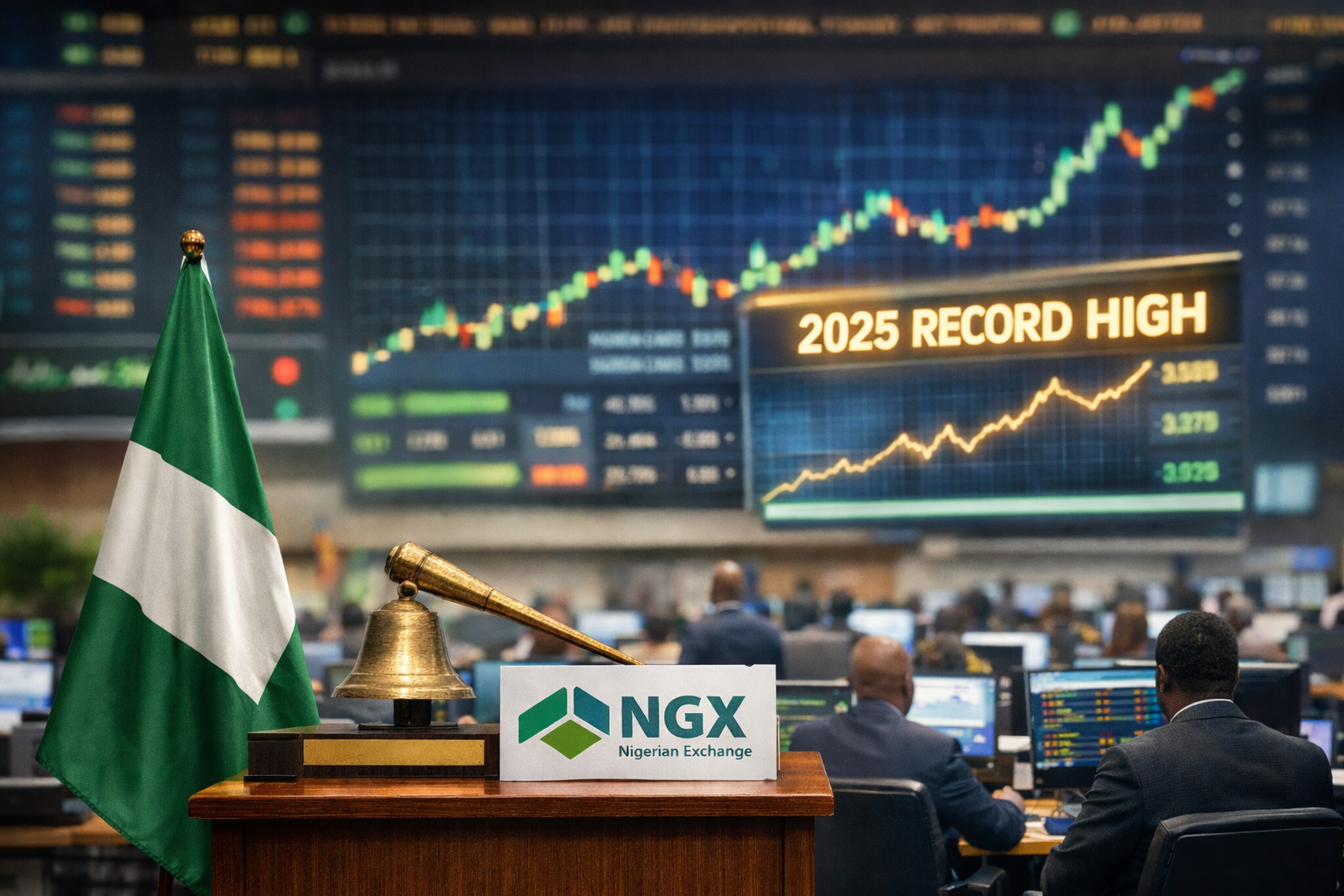
Nigeria’s Capital Market Breaks Record as NGX Turnover Surges to ₦11.23 Trillion in 2025.
Nigeria’s equities market delivered its strongest performance on record in 2025, with trading activity on the Nigerian Exchange (NGX) reaching an unprecedented ₦11.23 trillion. The milestone reflects a sharp rebound in foreign investor participation and growing confidence in Nigeria’s economic reform agenda.
Market data show that total trade value more than doubled from ₦5.59 trillion in 2024, representing a 101 per cent year-on-year increase. This marks the highest annual turnover ever recorded by the NGX and significantly outpaces previous years, including ₦3.58 trillion in 2023 and ₦2.32 trillion in 2022.
Analysts attribute the surge in turnover largely to renewed interest from foreign portfolio investors. In a notable shift, Nigeria recorded a net positive foreign capital flow for the first time in several years, as inflows exceeded outflows. This development suggests that overseas investors are not only returning to the market but are also increasingly willing to retain capital within the country.
The rise in foreign participation coincided with an exceptional year for Nigerian equities. By the end of 2025, the NGX All-Share Index (ASI) posted a full-year return of 51.19 per cent, translating into approximately ₦32.13 trillion in net capital gains. This performance placed Nigeria among the world’s top five best-performing equity markets.
Reacting to the strong results, the Group Managing Director of Nigerian Exchange Group Plc, Temi Popoola, described the rally as a reflection of renewed confidence in Nigeria’s economic direction.
According to Popoola, the capital market demonstrated resilience despite domestic and global headwinds. He emphasised that policy consistency, purposeful reforms, and strategic collaboration were critical in strengthening investor confidence. Continued investment in market technology, he noted, also improved transparency, efficiency, and access, supporting capital formation across the economy.
Popoola further acknowledged the role of the Federal Government’s reform momentum, highlighting clearer macroeconomic coordination and policy direction as key factors in restoring investor trust.
The Chairman of the Association of Securities Dealing Houses of Nigeria (ASHON), Mr. Sehinde Adenagbe, also linked the market’s strong performance to recent government reforms. He noted that since May 2023, Nigeria’s stock market has experienced sustained growth, with the All-Share Index rising by approximately 136 per cent between 2023 and 2025.
Adenagbe highlighted increased digitization of the economy and capital market as a major enabler, particularly for younger investors. Fintech-driven access, supported by the NGX Group, has broadened participation and deepened market liquidity.
Key policy developments cited as drivers of renewed foreign inflows include the Investment and Securities Act (ISA) 2025, Nigeria’s removal from the Financial Action Task Force (FATF) grey list, and reforms in the foreign exchange market. Improved transparency and stability in the forex system have reduced uncertainty and enhanced predictability for global investors.
Despite the strong performance, market leaders have called for further reforms to sustain momentum. Recommended actions include encouraging new listings, revitalising state-owned enterprises, and providing incentives for long-term institutional investors.
Concerns were also raised around the need for clarity on Capital Gains Tax policy and stronger efforts to address security challenges, which remain critical considerations for global investors.
From an investment perspective, Managing Director of GTI Capital, Mr. Kehinde Hassan, observed that equity markets often reflect a country’s broader economic standing. He noted that international investors remain highly sensitive to risk, stability, and policy credibility factors that will continue to shape Nigeria’s market outlook.
The NGX’s record performance in 2025 sends a strong signal to business leaders, policymakers, and investors. It underscores the role of credible reforms, institutional confidence, and market infrastructure in positioning capital markets as engines of economic growth in emerging economies.
Source: Tvcnews